Thursday, April 21, 2011

Three-day Work Week


   When I arranged this trip I was advised I could work through the entire week before the Easter holiday weekend, but today we were informed the clinic is closed on Thursday and Friday.  Samana Santa is a big holiday in Catholic Nicaragua and there will be lots of family-oriented religious festivals from Friday to Monday. The crucifixion and the resurrection will be played out as pageants on the streets. 
   The last day was a busy day with more complicated and sicker patients than we cared for over the last few days.
   An eleven-year old boy arrived with a cold, headache and a history of fainting during running. The latter complaint drew my attention.  He had fainted twice during exercise and on one occasion he was unconscious for ten minutes and his lips were blue during that time. Ouch!  He was overweight, which is uncommon in Nicaraguan children, but otherwise his exam was normal.  I arranged an ECG, which was also normal.  No evidence of QT prolongation, ischemia, or ventricular hypertrophy.  In Canada, a paediatric cardiologist would likely due an echocardiogram, a 24 hour holter monitor, and a treadmill test.  After reviewing this with Dr. Flores, I am hopeful that a cardiology consult and echocardiogram can be arranged in either Rivas or Managua.  
   A 33 month-old boy had an open fontanel.  The soft spot should close by about 20 months of age.  His head circumference was at the 85 percentile.  I asked Marta, the clinic nurse, to inquire about seizures and the mother described "absence" spells.  Likely this boy has hydrocephalus. In Canada, he would have a CT or MRI and EEG, a pediatric neurosurgical consultation for the hydrocephalus, and a pediatric neurology consultation for seizure control.  His neurological exam was otherwise normal without any evidence of increased intracranial pressure, but this will develop without surgical intervention.  After discussion with Dr. Flores, I am hopeful that a surgical consult in Managua can be arranged.  
   Kate and Sian came by and presented a cake to the clinic staff to thank them for their hospitality during their stay.
   While they were in the clinic they presented an information session on anemia with a poster they designed for the class.  
   In lieu of working at the clinic today, we decided on a road trip to Gigante, the fishing village where all the children we saw on Monday and Tuesday live. 

Wednesday, April 20, 2011

Another Truckload from Gigante


   Another truckload of children arrived from Gigante today.  Bo Fox reports that this fishing village is home to about 500 individuals of which 31% are children, according to a recent census conducted by Project Wave of Opportunity.  Over the last two days, we therefore saw about a quarter of the children. 
   None of the children were sick today and I mostly did well child checkups and answered the same kind of questions that many Canadian Mom’s might ask.  Many asked for a vitamin or tonic to stimulate appetite and I responded with nutrition advice.
   Most of the children were "dressed up" for the visit to the Canadian doctor.  Bo reports that they are mostly shoeless and wear only shorts and a T-shirt at home, but for the trip to the doctor they had pants or dresses, and shoes and socks.  


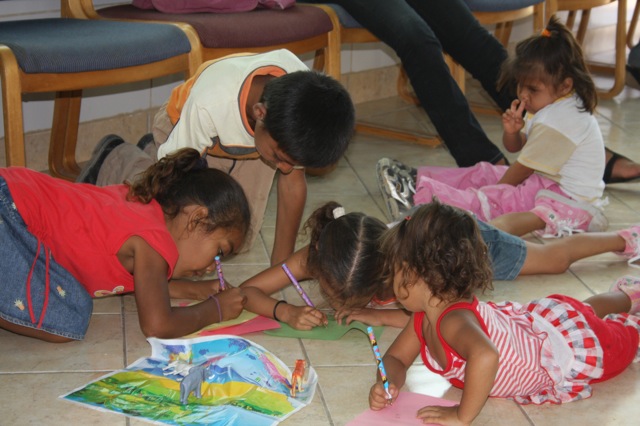
   Bo reports that today I saw the poorest families in the community. Apparently about twenty individuals live together in a communal arrangement in a home made of large pieces of plastic. The children were all well cared for, their teeth were not full of cavities, and they were happy and playful with their peers. By and large the Nicaraguan children were all very well behaved in the clinic. Karen reports that when they were playing outside they were more rambunctious and mischievous. Karen made sure the children had fun while they waited. 


   The team of Kate and Sian from Bristol, England, Bo Fox from the US, and Karen and I from Canada moved faster today.  Kate and Sian took the histories, I did the exams, Karen distracted the children, and Kate and Bo interpreted the treatment recommendations.  Bo and Kate  
                                                         Bo and Sian
                                              Kate with a happy little girl 
   We enjoyed dinner with Kate and Sian, to celebrate their last night in the area.  Tomorrow the will travel to Leon to enjoy the Samanta Sana festivities.  We had dinner at Yolanda's a local restaurant.  Yolanda greeted us like family when we walked in. She had a big smile and hug and we felt very welcome.  We had plantain chips, which were salted, and seem to be a local equivalent of the potato chip.  Large portion meals with fish or chicken, beans, rice, salad, and four Tona, the local beer, all for only $28.
   Bo Fox is an amazing fellow. He was full of energy, enthusiasm, and ideas.  I'm not sure how long he has been in Gigante, but he has clearly woven himself into the fabric of the community. His relationship with the mothers and children looked like family.  He sure made a difference for us. Thank you Bo!


Tuesday, April 19, 2011

Great Day in the Clinic


   A truckload of children were at the clinic when we arrived at 9:30 AM. The families were all from Gigante, a small community about 20 km away.   Bo Fox, who is a worker with Project Wave of Optimism, an organization with a mission to foster community development, was advised that a pediatrician would be available at the clinic, and he went door-to-door to identify families who might benefit.  Eighteen mothers and their children arrived and 7 hours later, after we saw the last patient at 4:30 PM, they left together.  Incredible to think that 18 mothers each spent an entire day away from their homes to spend about half an hour with a pediatrician.  
                                        Imagine 35 people in this truck!!!
   Two final-year medical students from Bristol, England were at the clinic. Their university arranged for them to volunteer at the clinic and also in the hospital in Rivas for two weeks.  Both of the students were fluent in Spanish and for the first time, I obtained a precise history from each mother.  The students translated for me and in return I served as a pediatric professor as well as a clinician.
   I designed a history and examination form, a two-page checklist, and I used this for the first time. The form definitely improved the data record and saved time. I used Google Translate only to document the diagnoses and the treatment recommendations.  The checklist and the Google Translate document, together with a growth chart, were stapled together at the end of the assessment and will become part of the permanent medical record for that child. 


   Karen assisted with record keeping, gave out toys, took photos, and arranged play activities for the children who patiently waited their turn. 

   The first patient of the day was the sickest. A 6 year-old boy presented with a two-day history of high fever. A week prior, he had a runny nose and cough without fever and someone had treated him with six days of amoxicillin. The day after he finished the antibiotic he developed the high fever. Today was the second day of fever and in the clinic his temperature was 39 degrees. He looked a bit toxic. He had very very red throat and he only coughed once but there was mild inspiratory stridor.  He had a small lymph node in the neck. The trachea did not feel tender.  His air entry was normal.  His exam was otherwise normal. I worried that this might be the start of a bacterial tracheitis or even epiglottitis. I do not think these children are immunized for H flu.  I had clavulinic acid available and I treated him with this antibiotic and with acetomenophen for fever. I made sure Mom knew to bring him back the next day if he was not improved and for Mom to take him straight to the hospital in Rivas, about 30 km away, if he developed difficult breathing or drooling. I will inquire about the boy today.  


Monday, April 18, 2011

Hummingbirds

   Hummingbird identification is a challenge.  The birds are tiny and usually don’t sit still long enough to even focus the binoculars, much less get a good look.  I learned years go to take a picture first.  With modern digital photography and a fast shutter speed, a sequence of photos can often provide enough information for later identification. 
    Yesterday morning I was standing along a stream under a forest canopy and waiting to see what might fly by.  I spotted two hummers by the edge of the stream. They hovered about a foot over some green algae-like growth in the shallowest part of the stream.  There were no flowers.  Hummingbirds eat insects and I wondered if this hummer ate insects that lived in the aquatic plants.  I started to take photos right away.  More hummingbirds arrived and I realized this was better than average photo opportunity.  I moved to put the sun behind me, which startled the hummers and they disappeared.  I stood still and waited, and they returned a few minutes later.  Over the course of the next fifteen minutes I took about a hundred photos of the hummers as they descended to bathe in the stream.  The hummingbirds usually arrived as a pair but sometimes there were three at a time.  They hovered looking down into the water and then they descended into the water and splashed around until their feathers were soaked, and then they flew off.
    Back at the casa I downloaded the photos and hoped there were enough images in focus to make identify the humminbird.  I hit the hummingbird jackpot!  The photos allowed a precise identification of four different species!  I had presumed I was only looking at one species.  
    A distinctive white band in the tail allowed identification of a Band-tailed Barbthroat.
   The tail shape and the purple breast and head separated by a green neck allowed identification of a Violet-crowned Woodynmph. The distinctive central green breast stripe allowed identification of a Green-breasted Mango. A great image of a thick coral-red bill with a black tip allowed identification of a Blue-throated Goldentail. 
    There might well have been more species present.  I have not done an internet search about hummingbird bathing behavior to know whether communal bathing is common.  Perhaps once a safe location is identified by one species others learn to tag along.  

Sunday, April 17, 2011

Fires in the Mountains


   Yesterday morning at dawn, I saw two columns of smoke in the distance. Within an hour the smoke turned into a cloud that moved with the wind. The amount of smoke looked larger than I would have expected from a small rubbish fire. 
   The smell of smoke was fairly strong in the air and both the smell and the amount of smoke grew over the day. The winds are generally brisk and by midday the smoke from one of the fires extended for about five kilometres down a valley and towards the ocean. As the sun set the smoke was replaced by flames that crept down the valley. I was up at about 1 AM and the flames were still visible but less intense. By dawn the flames were gone and there was no visible smoke.
   The area engulfed by the largest fire and the spread down the valley with the prevailing wind suggested to me that the fire was out of control. Accidental fires are likely common. There is no garbage service and refuse is burned on the property. Yesterday I drove by a large bonfire on the side of the road and there was no one attending the fire. This is the dry season and I imagine that some of these fires get out of control. Intentional fires are a common method to clear land in preparation for planting. There is no fire department and when either a refuse fire or a crop-clearing fire get out of control, the fires are obliged to burn out. 
   I shuddered to think about people who might have lived in the valley the flames engulfed. Presumably they would move out of harms way, but their possessions, some of their livestock, and the indigenous fauna might not escape.
   I checked for any news reports of fires in the region and of course there were no reports. What occurred to me is that a small community could disappear in the mountains and that these incidents might escape the attention of the local authorities.