Monday, April 18, 2011

Hummingbirds

   Hummingbird identification is a challenge.  The birds are tiny and usually don’t sit still long enough to even focus the binoculars, much less get a good look.  I learned years go to take a picture first.  With modern digital photography and a fast shutter speed, a sequence of photos can often provide enough information for later identification. 
    Yesterday morning I was standing along a stream under a forest canopy and waiting to see what might fly by.  I spotted two hummers by the edge of the stream. They hovered about a foot over some green algae-like growth in the shallowest part of the stream.  There were no flowers.  Hummingbirds eat insects and I wondered if this hummer ate insects that lived in the aquatic plants.  I started to take photos right away.  More hummingbirds arrived and I realized this was better than average photo opportunity.  I moved to put the sun behind me, which startled the hummers and they disappeared.  I stood still and waited, and they returned a few minutes later.  Over the course of the next fifteen minutes I took about a hundred photos of the hummers as they descended to bathe in the stream.  The hummingbirds usually arrived as a pair but sometimes there were three at a time.  They hovered looking down into the water and then they descended into the water and splashed around until their feathers were soaked, and then they flew off.
    Back at the casa I downloaded the photos and hoped there were enough images in focus to make identify the humminbird.  I hit the hummingbird jackpot!  The photos allowed a precise identification of four different species!  I had presumed I was only looking at one species.  
    A distinctive white band in the tail allowed identification of a Band-tailed Barbthroat.
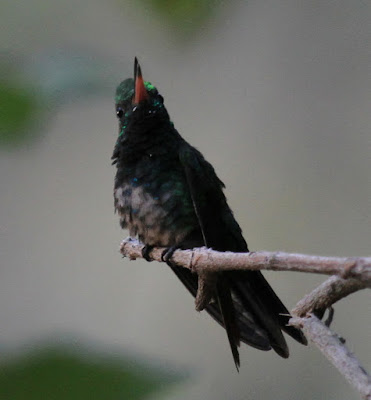
   The tail shape and the purple breast and head separated by a green neck allowed identification of a Violet-crowned Woodynmph. The distinctive central green breast stripe allowed identification of a Green-breasted Mango. A great image of a thick coral-red bill with a black tip allowed identification of a Blue-throated Goldentail. 
    There might well have been more species present.  I have not done an internet search about hummingbird bathing behavior to know whether communal bathing is common.  Perhaps once a safe location is identified by one species others learn to tag along.  

Sunday, April 17, 2011

Fires in the Mountains


   Yesterday morning at dawn, I saw two columns of smoke in the distance. Within an hour the smoke turned into a cloud that moved with the wind. The amount of smoke looked larger than I would have expected from a small rubbish fire. 
   The smell of smoke was fairly strong in the air and both the smell and the amount of smoke grew over the day. The winds are generally brisk and by midday the smoke from one of the fires extended for about five kilometres down a valley and towards the ocean. As the sun set the smoke was replaced by flames that crept down the valley. I was up at about 1 AM and the flames were still visible but less intense. By dawn the flames were gone and there was no visible smoke.
   The area engulfed by the largest fire and the spread down the valley with the prevailing wind suggested to me that the fire was out of control. Accidental fires are likely common. There is no garbage service and refuse is burned on the property. Yesterday I drove by a large bonfire on the side of the road and there was no one attending the fire. This is the dry season and I imagine that some of these fires get out of control. Intentional fires are a common method to clear land in preparation for planting. There is no fire department and when either a refuse fire or a crop-clearing fire get out of control, the fires are obliged to burn out. 
   I shuddered to think about people who might have lived in the valley the flames engulfed. Presumably they would move out of harms way, but their possessions, some of their livestock, and the indigenous fauna might not escape.
   I checked for any news reports of fires in the region and of course there were no reports. What occurred to me is that a small community could disappear in the mountains and that these incidents might escape the attention of the local authorities.  


Saturday, April 16, 2011

One Step Forward, Two Steps Backward

  I had arranged to meet with Rob, the local FIMRC organizer, to give him the customs receipt to retrieve the medications at the airport. I was advised that Rob would be at the Las Salinas clinic on Friday afternoon and on Saturday morning. Thereafter, the FIMRC group were scheduled to close down operations for the Easter Semana Santa week. I was scheduled to work at the Roberto Clemente clinic on Friday, so I advised FIMRC that I would drive to Las Salinas later on Friday afternoon. When I arrived at the clinic, there was no sign of Rob and after waiting for half an hour, I left.  I emailed the FIMRC folks and I had hoped to hear back with a revised time to meet Rob, but I haven't heard back.  This morning (Saturday) I will drive back to the clinic and I hope Rob or someone is there.  Otherwise, I guess that means the medications will not be used. Perhaps if the medications are still at the airport when I return to Canada, I can take them back home. This feels like a step backward.
   The second step backward is the lack of power and internet at the casa where we are staying. Lack of power means no ceiling fans and this means a very sticky sleep. Lack of power means flashlights and candles after 7 PM. Lack of power means no coffee in the morning.  Amazing what we take for granted.  
   The step forward yesterday was the work at the clinic.  We saw over ten families, most with more than one child, and courtesy of the portable printer, each mother was presented with treatment recommendations written in Spanish.  Another copy was signed and became part of the permanent medical record for the child. On this visit we started plotting weights on CDC growth charts.
   There were no seriously ill children yesterday. The common presenting complaints were poor appetite, poor weight gain, headaches, fever, and nosebleeds.  
   There were three children with headaches. One child had classic migraine, another child likely had migraine, and the cause in the third child was not clear to me. This last child had headaches that had routinely awakened him in the middle of the night for over a year!  When headaches wake a child, this is considered a "red flag" for a potentially serious neurological problem. His neurological exam was normal. He was only five years old but he cooperated well and he allowed me to visualize his discs with the ophthalmoscope and the margins were crisp, which was reassuring. In Canada this child would justify referral to a paediatric neurologist and he would likely have a CT scan. I discussed this with Dr. Flore, the clinic doctor, and if the boy does not improve, perhaps this can be arranged. I otherwise offered a variety of analgesia options for the mother to try. 
   One 11 year-old boy was overweight. Overweight children are not common in Nicaragua. Most are shorter and thinner than the average Canadian child. His blood pressure was borderline. Diabetes and hypertension are apparently very common in the adult population. I explained to Mom that her son was 9 kg overweight.  I outlined an exercise program with fast walking or jogging every day in the cooler hour immediately after dawn. I made specific nutrition recommendations. I advised Mom that if he didn't loose weight his risk for diabetes and hypertension was likely high. I know the Mom took these recommendations to heart because she has adult family members with diabetes.
   This first clinic day on the second trip felt like progress, and progress is good.
   We didn't manage any clinic photos so another gorgeous sunrise will have to suffice.   


Friday, April 15, 2011

Trouble with the Law

  After passport control, we picked up our bags from the carousel, and this time, to our relief, our bags made the journey with us. After piling the bags on a cart we proceeded to the customs area where we placed our bags on a conveyer belt that moved everything through a scanner.  
   "Is this your bag," the customs officer asked as soon as the bag emerged from the scanner.  
   "Yes," I replied.
   He pointed to a security area and implied that I needed to take the bags to be checked by hand. A pleasant young woman opened the bags and as soon as she saw the medications, her look advised me that we were in trouble. I gave her the letter, in Spanish, that FIMRC provided to vouch for the charitable reason for the medical supplies.  
   The woman asked one superior, and then he asked another superior, and then I was advised that without the proper official documentation, I could not bring the meds into the country.  
   I brought out my laptop, found a wireless link in the airport, and with Google Translator, I explained that I was a Canadian paediatrician, and that I needed to leave for Las Salinas in the morning, and that the medications were needed for the clinic.  
   No go. Rules are rules. No ticket, no entry.  
   So, we left without the medications, but with a receipt, signed and stamped, that advised that if we can arrange the necessary documentation, we can retrieve the supplies.  
   The next morning, at the Hotel Intercontinental Managua, I emailed Anna, my FIMRC contact, and advised her about the problem. She promptly responded that she would do what she could. 
   We picked up our Toyota Prado (Land Cruiser in Canada) at the hotel, and again with the help of Google Translate, I learned why the expensive maximal insurance coverage on the last trip did not cover me for the $375.00 scrape on the fender I unknowingly suffered in the "secure" parking lot at the Hotel Colon in Granada on the last day of our March trip. Nothing is covered without an official police report.  I'm not sure I would have tried to report a scrape to the police, even if I had known about the damage.  
   Well, I checked the Toyota very carefully this morning, and it occurs to me that I should have taken pictures with my digital camera to document the condition when I accepted the car. Next time. 
   We left the hotel for La Union, a supermercado, the Safeway or Sobeys, in Managua. We stocked up on produce, water, juice, and cooking supplies for the next 10 days, and packed everything in the Toyota. 
   Leaving the supermercado, I watched a white car turn left in a gap in a divided road and I presumed that I could make the turn as well.  Bad move.  Two policeman watched the white car drive by and then they pulled me over.  I had made an illegal left turn.  They saw me coming.  
   Neither of the two policemen spoke any English; why should they? I understood I had made a mistake and presumed the problem was an illegal left turn.  There was a policeman at my window and another policeman at Karen's window. Karen's Spanish is much better than mine. Neither of us could follow the dialogue well, but when the policeman at my window, now holding my drivers license, demonstrated how he intended to put my license into an envelope and seal the envelope, I realized my license was going to be confiscated.  
   Ouch!
   My heart rate picked up a few beats and I noticed that the air conditioning was not keeping my armpits dry.  
   I pulled out the FIMRC letter, written in Spanish, that described my work as a doctor, and which stated that I was delivering supplies to a clinic in Las Salinas.  The policeman at my window visibly softened. 
   However, by then, the other policeman, at Karen's window, had pointed to a paper with $100.00 written on a line, an amount that was presumably the fine for our infraction. 
   "I think he wants money Dad."
   I showed the other policeman the FIMRC paper but his demeanor did not soften. 
   I took out some bills and gave each of the policemen $10.00 US, and they sent us on our way with directions to Rivas. I'm old enough to remember when speeding tickets in Canada were about $25.00.
   I am confident that both those young policemen will submit the money to the necessary authority as honest individuals who are interested to prosecute the law in an honest and ethical fashion.  Well, maybe not.  
   The rest of our journey was much less exciting.  
   I was more relaxed on the crazy Nicaragua roads.  Nothing like experience. 


Wednesday, April 6, 2011

What went right and what needs to be improved for the next visit?

  What went very right was that we provided care to over 100 children in a rural area of Nicaragua. The families appreciated our care and their smiles as they left were affirmation of a positive and helpful impact on their lives. Most had traveled for one or two hours and then were obliged to wait for up to four hours to see us, and afterwards they traveled for another one to two hours to return home. Can you imagine the average Canadian family doing this to obtain routine health care? Maybe you can. There are some that say charity begins at home and that the Canadian Health Care system is in trouble, but that is another issue. Compared to Nicaragua, our health care is excellent.  
   What went right was that notwithstanding communication challenges, we connected satisfactorily with the mothers. I didn't say very good, I certainly didn't say excellent; I said, satisfactory.  This was positive but my Spanish skills need a lot of work and this will take time and practice. 
   What went right was that we provided much needed medications that will help families for many month to come. The two bags of medications we brought were the equivalent of about 20% of their available pharmaceutical stores!  
   The toys we brought for the children were a big hit.  We brought just enough and next time we will bring more. 
   Google Translate was a great help with communication. With the next visit we will bring a portable printer so that we can print out individualized treatment instructions for the mothers. Last weekend I purchased a Canon Pixma IP100 portable inkjet printer. The printer weighs only 4.4 pounds and is faster than the printer I have at home.  
   There are other clinics in the region that also deserve help and in the future I would like to work in a variety of situations and perhaps help to improve communication and cooperation between the clinics. You would think that in such a medically impoverished country that everyone would cooperate for the greater good, but politics, competition, and egos intervene everywhere.  
   I learned about an American charity, FIMRC, that has a mission to provide health care to children in poor countries.  They are working to establish a medical clinic for children in the region. I contacted them and there is a good possibility that I will collaborate with FIMRC during future visits.  The photo below shows the clinic in Las Salinas where FIMRC is working to establish a clinic for children. 
   From a logistical perspective, our Garmin NAVI GPS was very helpful to navigate from Managua to the remote area in southwestern Nicaragua. Kudos to Louise who was the navigator. We never got lost. 
   Some parents in my practice and some physicians who refer to me have asked to donate money to this project. Thank you!  I need to set up a Canadian Charity before I can accept money.  Spending my own money and accepting donations of medical supplies is one thing. Spending the money of another person is quite another thing. I am a do-it-by-the-book kind of guy. I like to cross the "t's" and dot the "i's." I cannot accept money without legal and financial accountability. I will keep you posted.
   We will visit again during the last two weeks of April. We will spend another week to gain experience and to determine if this is the correct venue to channel our efforts.  Karen, my daughter, will accompany me on this trip. She has time off courtesy of Spring Break.  
   There was nothing that really went wrong.  
   Yes, our luggage didn't arrive with us and we had to wait a half a day the next morning in Managua, but we still arrived at the clinic before sunset.  
   Yes, the left rear view mirror on the Toyota Land Cruiser was broken and limited my visibility on those crazy roads. 
   Yes, my Spanish was poor, but between the modest English of the clinic staff and my mediocre Spanish, and courtesy of Google Translate, the communication with mothers was satisfactory.   
   Yes, we did develop a flat tire on the second last day, but this was fixed and we made it back to the airport over those rough and tumble roads without a second flat tire, which really would have been a problem.
   Yes, someone did ding the Toyota, which somehow cost me $384 notwithstanding the maximum insurance coverage available. This happened in the "security lot" at the Hotel Colon in the center of Granada. The high wire fence and security guard protected the Toyota from thieves, but the close quarters allowed another "secured" car to hit mine.  They didn't report it.   
   Yes, there were strange bugs and one snake was spotted, but apart from some itchy bites, this was no different than the risks of a walk in the Alberta mountains when the bugs are biting.    
   So yes, there were lots of minor frustrations. But, there were more than enough smiles and successes to make the troubles all seem inconsequential. 
   This is the local trucking industry.  Carts like this, towed by an ox or horse, transport bricks, bananas, wood or whatever.  
   Lots of homes had a beehive kiln in the front yard. 
   This old wooden dugout was likely used on the rivers and lagoons that fed the Pacific.  
   Water wells were common.